
Prison Communication Systems & Vandal-Resistant Inmate Phones
Rugged inmate telephones, SIP intercoms, video communication terminals and help points for prisons, jails, detention centers and other secure facilities.
LightCom provides vandal-resistant communication hardware for correctional environments, with configurations for inmate calling, staff communication, control-room integration, visitation, emergency assistance and secure access points.

Choose Communication Solutions for Correctional Facilities
A single facility might need a dozen different communication configurations. LightCom terminals can be matched to the area they're installed in - from a housing unit that sees constant contact to a control room built for uptime.


What to Consider When Specifying Prison Communication Equipment
-
vandal resistance
-
tamper-resistant construction
-
stainless-steel enclosure
-
flush vs surface mounting
-
exposed cord vs protected/short cord
-
keypad requirements
-
SIP vs Analog
-
PoE / power
-
video requirement
-
control-room routing
-
accessibility requirements
-
cleaning and maintenance
-
replacement handset / spare parts
-
call-management system compatibility
-
mounting behind secure wall/panel
-
network and PBX integration
Prison Communication Applications & Recommended Equipment
Prison Video Intercom with Display and Keypad
When equipment is exposed to frequent use and intentional damage, standard commercial intercoms fall short. This is the terminal LightCom leads with for correctional environments.
For locations where voice-only communication is not sufficient, LightCom offers vandal-resistant SIP terminals with integrated video, display and keypad operation for controlled communication and identification workflows.
Vandal-Resistant SIP Video Intercom for Correctional Facilities

Video communication, keypad operation, and a vandal-resistant enclosure in one terminal - built into a broader SIP architecture so it can connect to staff, a control room, security personnel, or any designated endpoint your facility requires.
Where it's typically installed
-
Inmate communication points
-
Secure housing-unit communication
-
Staff-to-control-room communication
-
Controlled access areas
-
Visitation communication points
-
Security-sensitive corridors
-
Help and assistance stations
Recommended Prison & Correctional Communication Products


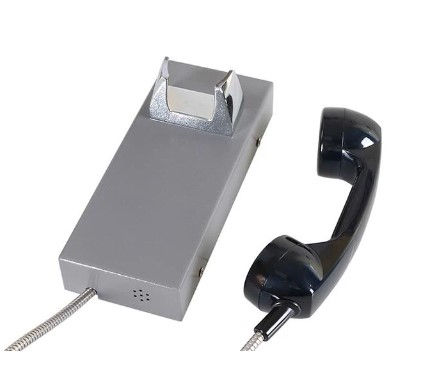

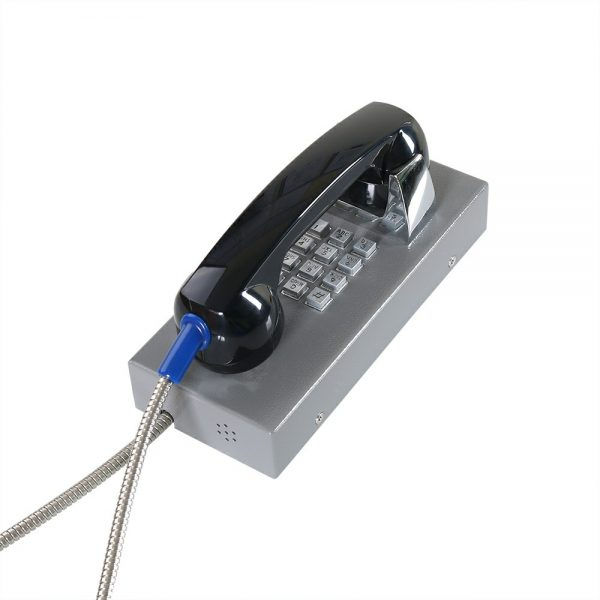


Anti-Ligature Prison Phone & Handset Cord Options
LightCom handset telephones can be configured with different handset cord lengths to suit the installation environment and project requirements.
Standard handset cord
32.7 in (83 cm)
Suitable for general industrial, commercial, public-safety and operational communication applications where a standard handset reach is preferred.
Anti-ligature short cord
14 in (35 cm)
Available for applications where a shorter handset cord is required, including correctional facilities, secure institutions and other controlled environments.
If the cord-length option is not shown on the product page for the model you need, please contact LightCom. We can prepare an invoice for the required telephone configuration with the selected handset cord length.
Prison Communication System Connection Options
LightCom prison phones, correctional intercoms, video terminals and help points can be integrated with existing analog telephone infrastructure, SIP/VoIP networks, IP PBX systems, and selected 4G LTE applications.
The appropriate architecture depends on the facility’s existing infrastructure, communication policy, endpoint location and required call-routing functions.
The diagrams below show four common ways rugged communication devices can be connected within prisons, jails, detention centers and other secure facilities.
1. Analog Prison Phones Connected to an Analog PBX / PABX
Analog inmate phones and correctional telephones can connect directly to an existing two-wire analog PBX / PABX infrastructure.
This configuration can be useful in facilities that already have analog telephone wiring and want to add or replace rugged inmate phones, staff telephones, corridor communication points or other fixed endpoints without replacing the existing telephone infrastructure.
Typical connection:
Analog Prison Phone → 2-Wire Telephone Line → Analog PBX / PABX → Control Room / Staff / Authorized Destination
This approach may be suitable for retrofit projects where the existing analog infrastructure remains operational.

2. Analog Prison Phones Connected Through a SIP Gateway
Existing analog prison phones can be connected to a modern SIP/VoIP communication system through an analog-to-SIP gateway.
This allows a facility to retain rugged analog field devices while routing calls through an IP PBX, SIP server or other compatible communication platform.
It can be useful during phased modernization projects where the facility wants to migrate toward IP-based communication without replacing every analog endpoint at the same time.
Typical connection:
Analog Prison Phone → Analog Line → SIP Gateway → Ethernet Network → IP PBX / SIP Server → Control Room
For inmate calling applications, additional call-control or management systems may be required depending on the facility’s operational requirements.

3. SIP Prison Phones & Intercoms Connected to an IP PBX
SIP/VoIP prison phones, intercoms and video terminals can connect directly to the facility’s Ethernet network and communicate through a compatible IP PBX or SIP server.
PoE-enabled models can receive network connectivity and power through the same Ethernet cable where suitable PoE infrastructure is available.
This architecture is well suited to:
-
inmate communication points
-
housing units
-
staff stations
-
secure corridors
-
control rooms
-
help points
-
controlled access locations
-
video intercom applications
Typical connection:
SIP Prison Phone / Intercom → Ethernet / PoE Switch → IP PBX / SIP Server → Control Room / Security / Authorized Endpoint
For video models:
SIP Video Intercom → PoE / Ethernet → Compatible SIP / Video Platform → Control Room
Compatibility with the selected PBX, SIP platform or video system should be confirmed during project configuration.

4. 4G LTE Communication for Remote or Standalone Secure Locations
A 4G LTE communication terminal can operate without a local analog telephone line or Ethernet connection.
This can be useful for selected correctional or secure-site applications where installing wired communication infrastructure is difficult, such as:
-
remote perimeter locations
-
detached secure buildings
-
temporary facilities
-
remote gates
-
isolated security posts
-
standalone help points
The device uses a compatible SIM card and cellular network to connect to configured destinations.
Typical connection:
4G LTE Communication Terminal → Cellular Network → Control Room / Security / Authorized Phone
4G/LTE operation depends on carrier service, SIM provisioning, supported LTE bands, signal strength and the required voice or data service. Compatibility should be confirmed before deployment.

Important Project Note
For correctional facilities, the physical telephone or intercom is only one part of the communication architecture.
Depending on the application, the complete system may also include:
PBX / SIP Server · Call Management · Control Room Stations · Network Switches · SIP Gateways · Video Platform · Recording or Monitoring Systems · Access-Control Integration
LightCom can help select the appropriate telephone or intercom interface for the project, but compatibility with the facility’s communication, security and call-management platform should be confirmed during system design.
Need help selecting the right prison communication architecture?
Vandal-Resistant Communication Terminals
Not every communication point needs video. These complement the LC213-KB-DP-S across other areas of a correctional or detention environment.
Case Studies and Insights
.png)
.png)
.png)
01.
20+ Years of Industrial Communication Expertise
02.
Global Shipping Available
03.
2-Year Manufacturer's Warranty
04.
Trusted Across Critical Industries
05.
Trusted in 10 Countries 100+ Projects Completed

Q1. What makes a prison phone different from a standard commercial telephone?
Prison phones are designed for high-use and security-sensitive environments. Depending on the model, they may include vandal-resistant metal construction, tamper-resistant mounting, reinforced handset components, protected keypads, flush mounting, and controlled communication functions. The required configuration depends on the facility and installation location.
Q2. Can prison phones connect to an existing SIP, VoIP, or analog PBX system?
Yes, depending on the model. Correctional facility phones and intercoms can be configured for SIP/VoIP or analog telephone infrastructure, allowing them to connect to compatible PBX, IP-PBX, control-room, or designated communication endpoints. Compatibility should be confirmed during project configuration.
Q3. Are video intercoms useful in correctional facilities?
Yes, where visual identification or two-way video communication is part of the operational requirement. A vandal-resistant SIP video intercom can be useful in controlled access areas, visitation points, secure corridors, staff communication locations, or other areas where voice-only communication is not enough.
Q4. What type of intercom is suitable for a correctional facility?
It depends on the installation environment and system requirements. Vandal-resistant SIP video intercoms, heavy-duty telephones, and protected help points can each fit different areas of a facility.
Q5. Can prison intercoms use SIP?
Yes. SIP-based intercoms can integrate with compatible IP telephone infrastructure and be configured as part of a broader communication system.
Q6. Can prison intercoms connect to a central control room?
Yes. Depending on the system architecture, terminals can be configured to communicate with a central control room, security desk, dispatch station, or other designated endpoint.
Q7. Do correctional facilities need video intercoms?
Not at every point. Video intercoms are most useful where visual identification or video communication is part of the facility's operational requirements.
Q8. Can prison communication equipment be customized?
Yes. Depending on the model, options may include mounting configuration, labeling or inscriptions, housing materials, colors, power options, and other project-specific requirements.