
Crane Communication Systems
Keep Every Lift Connected, Safe, and Under Control
Keep crane operators connected with the teams supporting every lift, move, and operation. LightCom provides fixed crane communication solutions for construction, port, industrial, and material-handling applications, configured around your site's infrastructure and communication requirements.

Crane Communication Challenges
Crane operators often work from elevated or isolated cabs where communication with personnel on the ground can be difficult. Noise, distance, moving equipment, weather exposure, and limited access to communication infrastructure can make handheld communication devices impractical as the only communication method.
A fixed crane communication system provides a dedicated communication point inside the operator cab, allowing the operator to contact assigned personnel or locations without relying solely on portable radios.
Typical communication requirements include:
-
Operator-to-ground crew communication
-
Operator-to-control-room communication
-
Maintenance and service communication
-
Supervisor or dispatch communication
-
Emergency calling
-
Hotline communication
-
Communication between crane and nearby work areas
How a Crane Communication System Works
A crane communication system can be designed around the communication infrastructure already available at the site. Depending on the crane and project requirements, the operator cab can connect through SIP/VoIP, analog PBX, or 4G/LTE.
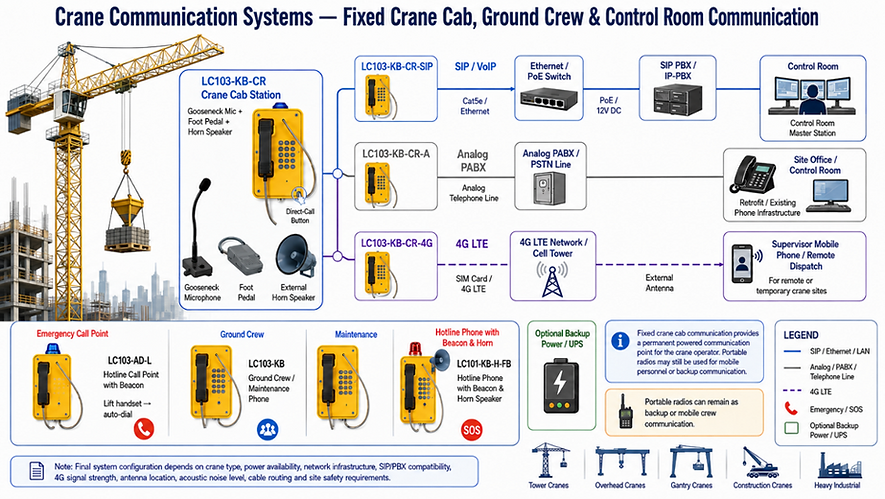
LightCom Telecom systems can connect the crane operator with control rooms, ground crews, maintenance teams, supervisors, emergency call points, and other communication endpoints. The architecture can be configured for individual cranes or expanded as part of a larger site communication system.
LC103-KB-CR Fixed Crane Cab Communication System
A fixed hands-free communication station designed for crane operator cabs. It can be configured for different communication architectures based on the crane and site infrastructure.
Key features:
-
Fixed cab installation
-
Hands-free communication
-
Gooseneck microphone
-
Foot pedal support where required
-
SIP, analog, or 4G/LTE configurations


Gantry Crane Communication Systems for Ports & Container Terminals
Communication systems designed around RTG, RMG, STS, container yard, and other port crane operations.


Communication Systems for Different Crane Operations
Crane communication requirements vary by crane type, operating environment, and site infrastructure. LightCom provides communication solutions for construction, port, industrial, and material-handling applications.


Fixed Crane Communication System vs. Walkie-Talkie Radios
Choose the Communication Architecture That Fits the Crane
SIP / VoIP
For cranes operating within facilities that already have Ethernet and SIP/VoIP infrastructure.
Best suited for:
-
Modern industrial facilities
-
Construction sites with network infrastructure
-
Ports and terminals with IP networks
-
Facilities using SIP-based communication
Analog PBX
For projects using an existing analog telephone system or for retrofit applications where analog infrastructure is already available.
Best suited for:
-
Existing industrial facilities
-
Analog retrofit projects
-
Sites with established PBX infrastructure
4G/LTE
For cranes where fixed network cabling is difficult or unavailable, provided suitable cellular coverage is available.
Best suited for:
-
Remote cranes
-
Temporary installations
-
Construction sites
-
Locations where Ethernet cabling is impractical
Crane Communication System FAQs
1. What should I consider when selecting a communication system for a crane?
Consider the crane type, operator cab location, number of communication points, available power, existing site infrastructure, operating environment, and where the operator needs to communicate.
2. How do I determine how many communication points are needed?
The number of communication points depends on the crane operation and who needs to communicate with the operator. Consider control rooms, ground crews, maintenance areas, supervisors, emergency locations, and other regularly used communication points.
3. What information should I provide when requesting a crane communication solution?
Providing the crane type, number of cranes, crane or site drawings, operator cab location, existing communication infrastructure, available power, communication destinations, and any known environmental or installation constraints can help with preliminary system planning.
4. Can the communication system be expanded if more cranes are added later?
A system can be planned with future expansion in mind. The appropriate approach depends on the communication architecture, number of endpoints, network infrastructure, and how additional cranes will be connected.
5. Can the crane communication system be customized for a specific application?
Yes. Equipment selection and configuration can be adapted to the crane type, installation environment, communication requirements, and available infrastructure. Project requirements should be reviewed before final equipment selection.

Compliance & Regulatory Standards





CLIENTS
Tested and Trusted by Leading Industries


