
How Can Emergency Communication Prevent Tragedies in High-Risk Environments?
In high-risk environments, response time can directly influence the outcome of an incident. A missed alert or delayed call for help can allow a manageable situation to escalate. The real question isn’t whether communication matters, but how the right emergency communication system helps control incidents before they worsen.
Imagine a worker detecting a gas leak in a refinery or a driver trapped inside a tunnel after a collision. While automatic systems such as gas detection or fire suppression play a critical role, effective communication ensures responders can assess conditions, give instructions, and coordinate action without delay.
Understanding how these systems are designed, routed, and integrated into safety protocols is essential for preventing escalation in high-risk settings.

How Emergency Communication Prevents Tragedies
Emergency communication systems save lives by ensuring help is called instantly, instructions are clear during chaos, and connections stay active even if power or networks fail. Key benefits include reducing response time, providing clear guidance in emergencies, and maintaining communication during infrastructure failures.
1. Reduces Response Time
When an incident is reported immediately, responders can act without hesitation. In high-risk environments, even a short delay can dramatically increase the severity of an outcome. Consider a worker exposed to toxic gas who activates a one-button SOS phone.
The call is automatically routed to security or a control room, evacuation protocols begin at once, and medical assistance is dispatched within minutes. Without that direct and immediate communication link, the exposure could continue unnoticed, allowing the situation to escalate. Early reporting limits exposure, supports faster containment, and reduces the overall impact of the incident.
2. Enables Clear Instructions During Chaos
In high-noise or high-stress environments, such as factories, mining operations, or transportation hubs, clear verbal coordination can quickly break down. Machinery noise, alarms, and panic make it difficult for workers to understand what is happening or what they should do next.
Emergency communication systems address this challenge by providing direct two-way voice communication between the affected area and trained responders. They can also deliver pre-recorded evacuation announcements and integrate seamlessly with control rooms to centralize decision-making.
This structured flow of information ensures that people receive accurate, authoritative instructions rather than relying on confusion, assumptions, or rumors during a critical moment.
3. Maintains Communication During Infrastructure Failure
Power outages, network disruptions, or fire damage can disable primary communication systems at critical moments. If emergency devices rely on a single power source or network path, they can fail when they are needed most.
Well-designed systems incorporate planned redundancy, such as battery backup, analog fallback lines, or cellular (4G) connectivity where coverage is reliable. However, these features are not universal. Many facilities rely solely on SIP/VoIP infrastructure or lack properly maintained backup power.
In high-risk environments, redundancy should be a deliberate design requirement, not an assumption.

Related Articles:
How Does an Emergency Communication System Work?
An effective emergency communication system follows a simple but structured process, ensuring rapid alerts, coordinated responses, and reliable connections every time.
1. Activation: Users initiate communication through a push-button SOS phone, handset auto-dial, or hands-free intercom. The goal is instant connection without dialing.
2. Automatic Routing: Calls are pre-programmed to connect directly to security teams, facility management, or emergency services using analog lines, SIP/VoIP networks, or cellular connectivity.
3. Two-Way Coordination: Responders assess the situation in real time, provide instructions, and dispatch appropriate resources. In advanced environments, integration with cameras or building management systems improves situational awareness.
Proactive Health Monitoring: Ensuring Emergency Systems Are Always Operational
In high-risk environments, installing an emergency communication system is only the first step. Ensuring that the system remains continuously operational is equally critical. Modern industrial emergency phones are designed with proactive health monitoring, allowing maintenance teams to verify device status and detect potential failures before an incident occurs.
At LightCom, many emergency communication solutions are engineered with built-in diagnostic capabilities, enabling devices to report their operational status automatically. This “self-aware” approach helps facilities monitor system health and maintain communication readiness without relying solely on manual inspections.
Different communication technologies support different monitoring approaches:
SIP / VoIP Emergency Phones
IP-based emergency phones can support advanced monitoring features such as audio loopback self-testing, which automatically verifies that the microphone and speaker are functioning correctly.
Many systems also support SNMP (Simple Network Management Protocol) monitoring, allowing facility IT teams to track device status, connectivity, and alerts through centralized network management tools.
4G / Cellular Emergency Phones
Cellular-enabled emergency phones can provide SMS heartbeat messages that periodically report the device’s operational status. These messages may include battery levels, signal strength, and connectivity status, enabling remote diagnostics and reducing the risk of undetected device failure.
Analog Emergency Phones
Traditional analog emergency phones can also include heartbeat call functionality. With this feature, the phone automatically calls a predefined service number at scheduled intervals, such as once per day or once per week. If the expected call is not received, maintenance teams know immediately that the device may be offline and requires inspection.
Note: By combining rugged hardware with proactive diagnostics, emergency communication systems can remain continuously monitored, predictable, and reliable, ensuring that help is always reachable when it matters most.
Who Needs Emergency Communication Systems?
Facility Type | Specific Risks | Why Emergency Communication Is Needed |
Oil & Gas Facilities | Fire, explosion, toxic gas release, high noise levels | Structured communication supports coordinated shutdown procedures and personnel accountability in hazardous environments. |
Mining Operations | Remote, underground work areas, machinery noise, hazardous materials | Fixed communication ensures dependable connectivity in remote underground environments. |
Manufacturing Plants | Heavy machinery, chemical exposure, high ambient noise | Durable systems provide instant coordination and clear instructions to reduce injuries and operational downtime. |
Transportation Hubs | Large crowds, traffic accidents, ambient noise | Centralized communication enables coordinated crowd management and emergency oversight. |
Tunnels & Highways | Vehicle collisions, fires, ventilation issues, traffic noise | Direct communication with monitoring centers provides guided assistance and situational coordination in confined or isolated spaces. |
Warehouses & Logistics Centers | Expansive layouts, isolated zones, loud equipment | Clearly positioned call points improve coverage across large, segmented layouts. |
Correctional Facilities | Security incidents, high activity noise | Centralized, controlled communication allows staff to respond quickly and maintain safety. |
Public Campuses | High foot traffic, emergencies, ambient noise, compliance requirements | Accessible emergency call systems provide instant assistance, meet safety standards, and reduce risks to the public. |
Invest in Emergency Industrial Phones Designed for Tough Conditions
Not all emergency phones are designed for demanding industrial environments. In high-risk facilities, communication equipment must remain operational during harsh weather, heavy noise, physical impact, and potential infrastructure failures. Choosing the right emergency communication system ensures both worker safety and reliable incident coordination.
In addition to durability, many industries require communication equipment that complies with recognized safety and protection standards. These certifications help ensure the devices perform reliably under extreme environmental conditions and meet regulatory expectations.
Key features to look for include:
IP66–IP67 ratings for protection against dust, heavy rain, and water ingress
ATEX / IECEx certification for use in explosive or hazardous environments such as oil, gas, and chemical facilities
IK10 impact resistance to protect devices from vandalism or mechanical damage
Analog, SIP/VoIP, or 4G connectivity to match the facility’s communication infrastructure
Noise reduction technology for clear audio in high-decibel environments
Visual alerts, such as beacon lights or strobes, to improve visibility during emergencies
Battery backup or redundant communication paths to maintain operation during power outages
Manufacturers such as LightCom specialize in rugged industrial emergency phones designed for demanding sectors like oil & gas, mining, and transport infrastructure.
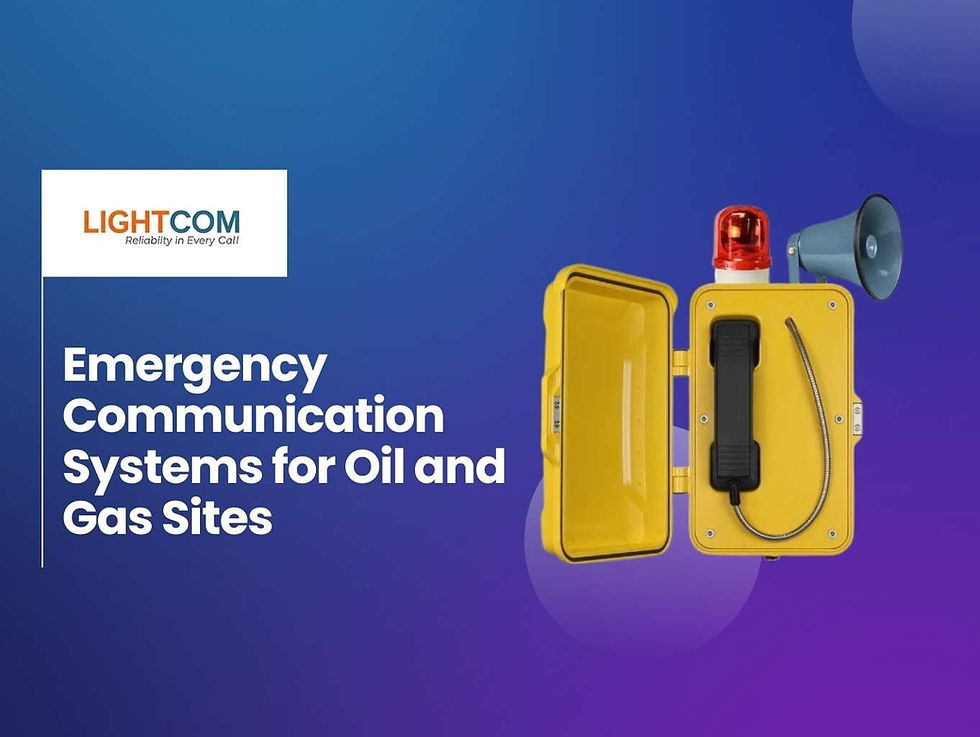
For example, one-button emergency telephones with integrated beacon lights can immediately alert both on-site personnel and remote control rooms in loud environments. The priority should always be long-term reliability and redundancy, not just upfront cost.

Actionable Steps to Improve Emergency Communication
Conduct a risk assessment of your facility.
Identify high-risk zones and isolated areas.
Determine required communication redundancy.
Choose weatherproof or explosion-proof devices as needed.
Integrate systems with your control room.
Train staff on usage protocols.
Test systems regularly.
Effective emergency communication depends on structured design, infrastructure resilience, and ongoing system testing.
FAQs
1. What is the difference between an emergency phone and a regular phone?
Emergency phones are dedicated, pre-programmed devices designed for instant activation, high durability, and operation in harsh environments. They often include beacons, noise reduction, and redundancy.
2. Do emergency communication systems work during power outages?
Many professionally designed systems incorporate battery backup or network redundancy. However, performance during power or network failures depends on system architecture and maintenance.
3. How often should emergency communication systems be tested?
Periodic functional testing is recommended, typically on a monthly or quarterly basis, depending on regulatory requirements and the facility’s risk level. Regular testing ensures call routing, audio clarity, and system reliability remain fully operational.


Comments