
Emergency Phone for Mine Tours: LC103-1PB-A Installed at Last Chance Mine Museum

A Rugged Emergency Communication Point for a Historic Colorado Mine
Some visitor attractions are easy to protect with standard communication equipment.
A historic mine is not one of them.
LightCom supplied the LC103-1PB-A rugged analog emergency phone for Last Chance Mine Museum in Creede, Colorado — a historic 1891 silver mine site that today welcomes visitors for rocks, minerals, tours, and museum experiences. The site describes itself as an 1891 silver mine with rocks, minerals, tours, and a museum, located at 504 Last Chance Mine Rd, Creede, CO 81130.
This is exactly the kind of location where emergency communication has to be simple, visible, durable, and ready for real-world use.
A mine museum is not a clean office lobby. It can include outdoor areas, old structures, uneven terrain, dust, temperature changes, public visitors, guides, maintenance activity, and spaces where cell phone reception or visitor awareness may not be reliable.
For this type of environment, the emergency phone cannot be fragile.
It has to be obvious. It has to be rugged.And it has to be easy to use under stress.
That was the reason for using the LC103-1PB-A.

Why a Mine Tour Site Needs a Different Kind of Emergency Phone
Historic mine attractions have a unique safety profile.
Visitors may arrive for a museum, a guided tour, rock and mineral collecting, or a historical experience. But the environment around them is still very different from a standard commercial building.
Last Chance Mine promotes mine tours and free museums, and its tour information notes practical conditions such as appropriate footwear and tunnel temperatures around 50°F, with jackets or sweatshirts recommended.
That detail matters.
When a site includes tunnels, old mine structures, outdoor terrain, and visitor activity, emergency communication should not depend only on someone’s mobile phone. In remote or rugged sites, the better approach is often to install a fixed communication point that staff and visitors can recognize immediately.
A fixed emergency phone gives the site a dedicated call point.
Not a personal device. Not a visitor’s phone.Not a staff member who may be somewhere else.
A real emergency phone, installed in a known location.
The Challenge: Simple Emergency Calling in a Rugged Visitor Environment
For a site like Last Chance Mine Museum, the emergency phone needed to solve several practical problems.
First, it had to be easy to use. In an emergency, nobody should be reading long instructions or trying to figure out which number to dial.
Second, it had to survive the environment. Mine-related sites can involve dust, moisture, temperature swings, and rough public use.
Third, it needed to be suitable for a location where reliability matters more than extra features.
That is why a one-button analog emergency phone makes sense.
The LC103-1PB-A gives users a direct, simple action: press the button and connect to the assigned emergency or response number.
For mine tours and museum environments, that simplicity is often more important than a full keypad.
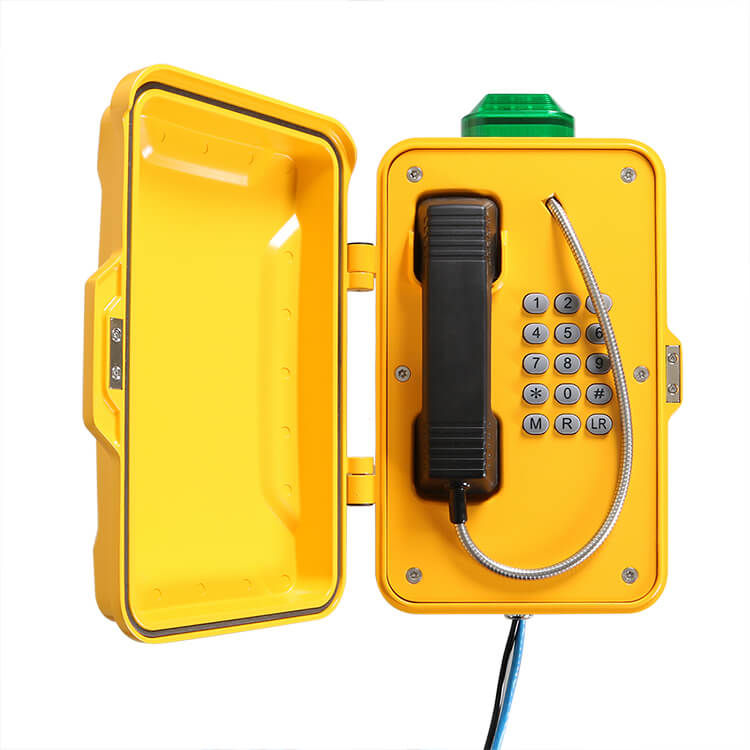
The Device: LC103-1PB-A Rugged Analog Emergency Phone
The LC103 series is designed as a heavy-duty industrial weatherproof hotline phone platform for demanding environments. The product line supports Analog, SIP/VoIP, and 4G LTE versions, with rugged construction for industrial, mining, transportation, public safety, and outdoor applications.
For this project, the selected model was the LC103-1PB-A:
LC103 — rugged industrial weatherproof phone platform
1PB — one push button for simple calling
A — analog version
This configuration is a strong fit when the customer has or can provide an analog phone line or analog PBX connection and wants a simple fixed emergency phone without the complexity of network configuration.
The analog version is compatible with standard 2-wire analog lines, analog PBX, and PSTN connections, and it is powered from the telephone line.
For many emergency call points, that is a major benefit.
No local power supply is required for the analog phone itself. No network switch is needed at the phone. No SIP account needs to be configured.
Just a durable analog emergency phone connected to the appropriate line.
Why One Button Is Often Better Than a Keypad
In a normal office, a keypad is useful.
In an emergency call point, a keypad can become a problem.
A visitor may not know which number to dial. A stressed person may press the wrong button. A keypad also adds more surface area and more opportunity for misuse.
For a mine museum or guided tour environment, a single emergency button is usually a cleaner solution.
The user does not need to think.
They press the button, and the phone calls the programmed destination.
That destination can be a front desk, guide station, manager, security point, emergency response contact, or other number selected by the site.
The goal is not to provide many options.
The goal is to provide one clear path to help.
Built for the Kind of Place Where Standard Phones Do Not Belong
The LC103 platform is built for harsh environments. The product features a corrosion-resistant aluminum alloy enclosure, IP67-rated environmental protection, and vandal-resistant construction for high-traffic or unmonitored areas.
The phone also includes a vandal-resistant handset made from molded BMC with an armored cord, a magnetic hook switch with no moving parts, and a wide operating temperature range of -40°C to +65°C / -40°F to +149°F.
Those details are important for a mine tour site.
A standard indoor phone may work for a while, but it is not designed for public use in a rugged attraction environment. The handset can be damaged. The cord can be pulled. The housing can fail from moisture, dust, vibration, or impact.
The LC103-1PB-A is designed for the opposite purpose.
It is intended to remain available in places where communication equipment may be exposed to real physical conditions.
Why This Project Matters for Other Mine Tours and Historic Sites
Last Chance Mine is not just a museum building. It is a restored historic mining site connected to Colorado’s mining history. Its history page notes that the mine was started in 1891, when Ralph Granger and Eric Von Buddenbrock grubstaked Theodore Renninger.
That type of site has a different responsibility than a typical indoor attraction.
Visitors come for authenticity.They want to experience history. They may walk through spaces that feel old, rugged, and real.
But safety communication still has to be modern and dependable.
That balance is important for many similar sites:
Mine museums
Underground tours
Historic industrial sites
Caves and cavern tours
Remote tourist attractions
Outdoor museums
Parks and heritage sites
Visitor centers with rugged terrain
Industrial history attractions
Public sites with limited staff visibility
A rugged emergency phone gives these locations a fixed and visible point of communication.
What Customers Should Consider Before Installing an Emergency Phone at a Mine Tour Site
A successful emergency phone installation is not only about selecting the device. The site should also think through how the phone will actually be used.
1. Where will a person most likely need help?
The emergency phone should be placed where it is visible and practical. In a mine tour environment, this may be near a tour entrance, staging area, museum area, tunnel access point, gift shop, parking area, guide station, or another critical location.
2. Who should receive the call?
The call can be routed to a manager, guide, front desk, security point, emergency contact, or external response number. The most important point is that the receiving party understands where the call is coming from.
3. Should the phone have a button, handset, or both?
For many public sites, a one-button phone is the easiest. A handset can improve call clarity and privacy, while the push button makes the call process obvious.
4. Is analog, SIP, or 4G the right connection?
Analog is a good option when a reliable phone line or analog PBX is available. SIP/VoIP is better when the site has network infrastructure and wants PBX integration. 4G LTE is useful when there is no practical wired connection but cellular coverage is available.
The LC103 platform supports multiple communication options, including analog, SIP/VoIP, and 4G LTE versions.
5. How often will the phone be tested?
Emergency phones should be tested on a regular schedule. A simple monthly or seasonal test procedure can help confirm that the phone dials correctly, audio is clear, and the receiving party knows how to respond.
6. Does the phone need signage?
A phone is much more useful when visitors and staff can identify it quickly. A clear label such as “Emergency Phone” or “Push Button for Help” can reduce hesitation during a stressful moment.
Why an Analog Emergency Phone Was a Practical Choice
The LC103-1PB-A analog version is a practical choice when the site already has a suitable analog connection or wants a simple line-powered emergency phone.
Analog phones still have a place in emergency communication because they are straightforward and familiar. They do not require IP addressing, SIP registration, network troubleshooting, or local PoE infrastructure.
For many rugged or historic locations, that simplicity is valuable.
The analog version of this product is compatible with standard 2-wire analog lines and is powered by the telephone line.
That makes it suitable for customers who want a reliable, dedicated emergency phone without adding unnecessary technology.
A Better Visitor Safety Experience
A good emergency phone does not need to be complicated.
It needs to answer one question:
If something happens, how does a visitor or staff member call for help immediately?
For Last Chance Mine Museum, the LC103-1PB-A provides a fixed emergency communication point designed for a rugged public environment.
The user does not need to search for a number. The site does not need to rely only on personal cell phones.The phone is built for difficult conditions.The call path is direct and simple.
That is exactly what an emergency phone for mine tours should do.
Applications Beyond Mine Museums
Although this project was completed for Last Chance Mine Museum, the same approach applies to many other facilities where public safety and rugged conditions overlap.
The LC103-1PB-A and related LC103 configurations can be considered for:
Underground tour sites
Historic mine attractions
Visitor centers in remote areas
Outdoor museums
Industrial heritage sites
Caves and cavern tours
Parks and trails
Maintenance areas
Parking lots
Remote gates
Utility sites
Industrial facilities
Transportation and tunnel environments
The product platform is designed for demanding environments such as tunnels, mining, marine, underground areas, metro stations, railway platforms, highways, parking lots, steel plants, chemical plants, and power plants.
Final Thought: Safety Communication Should Be Easy to Find and Easy to Use
A historic mine tour should feel authentic.
Emergency communication should not feel uncertain.
The LC103-1PB-A installed at Last Chance Mine Museum is a good example of how a rugged emergency phone can support visitor safety without overcomplicating the site.
It gives staff and visitors a clear, fixed point of communication.
It is simple. It is durable. It is purpose-built for harsh environments.
For mine tours, museums, parks, and remote visitor attractions, that combination matters.
Need an Emergency Phone for a Mine Tour, Museum, or Remote Visitor Site?
LightCom helps customers select rugged emergency phones for real site conditions, including analog, SIP/VoIP, and 4G LTE configurations.
For mine tours, historic sites, museums, outdoor attractions, industrial facilities, and remote areas, we can help determine the right configuration based on:
Available communication infrastructure
Analog, SIP, or 4G requirements
Mounting location
Weather exposure
Visitor access
Call routing
Signage and labeling
Handset or hands-free operation
Power availability
Emergency response procedure
When the goal is a simple and durable emergency phone for mine tours, the LC103-1PB-A rugged analog emergency phone is a practical solution.


Comments